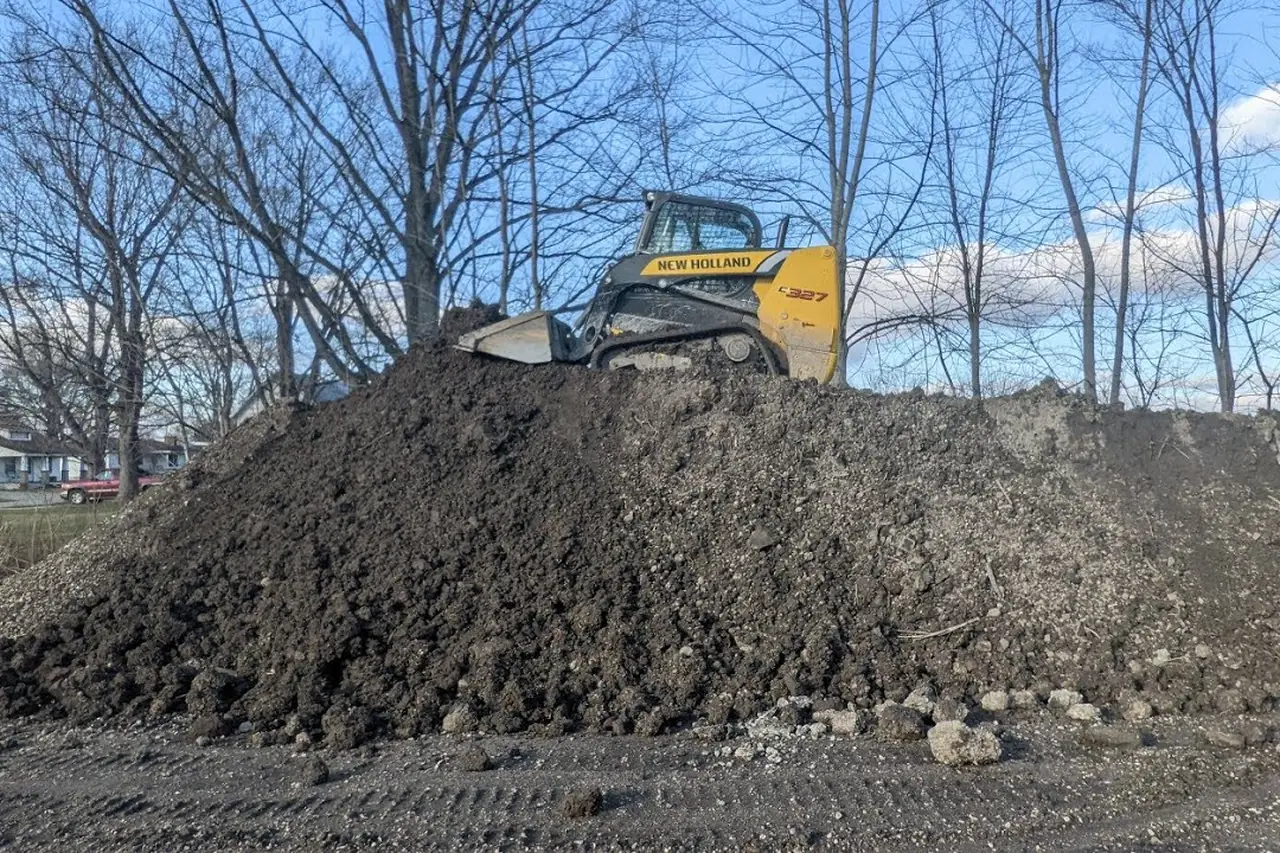
Fill Dirt Cost in Oklahoma: 2026 Prices Per Yard and Per Truckload
Fill dirt costs $5 to $25 per cubic yard in HomeGuide’s cost guide. HomeGuide prices a delivered dump truckload at $150 to $400. Angi puts its 2026 national average fill dirt project at $842. Delivery and spreading come on top of the dirt itself.
We bring fill in on our gooseneck dump trailer for dirt work and grading around Duncan. Then we spread it and pack it down. This guide lays out the published prices and the math for how much to order.
What does fill dirt cost in 2026?
Plain fill dirt runs $5 to $25 per cubic yard in HomeGuide’s data, or $4 to $15 per ton. Angi’s 2026 guide puts unscreened fill at $8 to $15 per yard and clean fill at $10 to $18. Structural fill and topsoil cost more per yard.
| Item | Published price | Source |
|---|---|---|
| Fill dirt, per cubic yard | $5 to $25 | HomeGuide |
| Unscreened fill, per cubic yard | $8 to $15 | Angi 2026 |
| Clean fill, per cubic yard | $10 to $18 | Angi 2026 |
| Dump truckload of fill dirt, delivered | $150 to $400 | HomeGuide |
| Structural or engineered fill, per cubic yard | $10 to $30 | HomeGuide |
| Structural fill, per cubic yard | $15 to $25 | Angi 2026 |
| Topsoil, bulk, per cubic yard | $10 to $50 | HomeGuide |
| Topsoil, dump truck load delivered | $150 to $500 | HomeGuide |
| Sand, bulk, per cubic yard | $15 to $50 | HomeGuide |
| Dirt delivery fee | $50 to $150 | HomeGuide |
| Installation and rough spreading | $200 to $400 | HomeGuide |
These are national market figures, not our prices. Angi says suppliers often set minimum order requirements, and buying in bulk often lowers the per-yard rate. HomeGuide says most delivery companies require a 2-yard minimum.
Bulk sand runs $15 to $50 per cubic yard in HomeGuide’s data. HomeGuide lists construction sand for use below a swimming pool. Our guide to leveling ground for an above ground pool covers that job.
Our part of that table is the spreading. We do not sell dirt or run a stand-alone dirt delivery service, and we have no dump truck. On a grading, pad or low-spot job, our gooseneck dump trailer brings fill in a few loads at a time. For a big delivery, you buy the dirt from a supplier and we spread it.
Fill dirt, select fill or topsoil: which one does your job need?
It depends on what sits on top of the dirt. Plain fill raises grade and fills low spots in a yard. Under a slab or a building pad, the fill has to meet code and pack tight. Topsoil belongs only on top, where grass has to root.
HomeGuide describes standard fill dirt as an inorganic subsoil of broken rock, clay, sand and debris. Angi warns that mixed fill holding debris or organic material can cause unpredictable settling over time. For yard leveling and grading, clean fill is the safer buy.
Under a slab, the 2018 residential code Oklahoma adopts sets the rules. Section R506.2 has all vegetation, topsoil and foreign material removed inside the foundation walls. Section R506.2.1 wants the fill free of vegetation and foreign material, compacted in 8 to 12 inch lifts. Unless approved, the Oklahoma code caps that earth fill at 8 inches, and clean sand or gravel at 48.
Ask what any quote means by select fill, since neither Angi nor HomeGuide prices a grade by that name. Both price structural or engineered fill instead. Angi says structural fill is engineered for compaction and stability, the right choice under foundations or roads. HomeGuide puts engineered or structural fill at $10 to $30 per cubic yard.
Pads are their own job, covered on our site prep and building pad page. Our building pad cost guide prices the whole pad.
Topsoil does the opposite job. HomeGuide calls it the surface layer that contains organic matter, and says highly compacted dirt is not ideal for gardens. HomeGuide gives 4 to 6 inches as the topsoil depth for a new lawn. So fill goes underneath and gets packed, and topsoil goes on last.
How much fill dirt do you need?
Multiply length by width by depth, all in feet, then divide by 27 to get cubic yards. That is the formula Angi gives, and Angi says to round up. Then add a cushion, since HomeGuide adds 5 to 10 percent for waste and spills.
Say a low spot runs 20 by 30 feet and needs 6 inches. That is 300 cubic feet, or about 11 cubic yards. With the top of HomeGuide’s cushion, it comes to about 12 yards. A 50 by 100 foot area raised a foot takes about 185 yards before the cushion.
Settling is the other allowance, and the clearest published numbers are for pond dams. The USDA pond handbook builds a rolled-fill earth dam about 5 percent taller than its design height. Most pond dams under 20 feet are not rolled fill, and for those the USDA allows about 10 percent. The same handbook says a dam compacted in thin layers at good moisture should show little settling in the fill itself.
HomeGuide says one truck load typically holds 10 to 14 cubic yards. By that count, the 12-yard low spot is about one truckload, and the 185-yard area takes 14 to 19 loads. An order that size comes from a supplier’s dump trucks, and we spread it.
Why does Oklahoma clay change the job?
Clay holds water and swells with it. OSU Extension says many soils in Oklahoma have little sand content. With heavier soils, OSU says the ground does not soak up water very fast. The Oklahoma Geological Survey says over 75 percent of the state’s bedrock units are possible sources for expansive soils.
The Oklahoma Geological Survey says montmorillonite clay can swell to 1.5 to 2.0 times its dry volume when wet. Fill placed against a house has to shed that water away from the walls. Oklahoma’s residential code wants the grade to fall at least 6 inches in the first 10 feet from the foundation.
A low spot filled flat against the wall misses that slope. When fill alone cannot move the water, drainage work may be the better fix. Our yard drainage guide goes further.
How the fill goes in matters as much as the dirt. The residential code compacts fill under a slab in 8 to 12 inch lifts. The USDA pond handbook says fill is moist enough to compact when it forms a firm ball that sticks together. We spread fill in layers and pack each one before the next goes down.
What adds to the bill besides the dirt?
Moving and placing it. HomeGuide puts dirt delivery at $50 to $150, plus hauling fees of $10 per mile past 5 miles. HomeGuide adds $200 to $400 for installation and rough spreading. Angi says spreading and compacting with heavy machinery may be billed separately, so ask what each quote covers.
Access moves the number too. HomeGuide says fully loaded dump trucks can leave cracks in concrete driveways and curbs. HomeGuide also says to avoid driving a loaded dump truck in your yard when the ground is wet. A tight backyard or soft clay after rain can mean smaller loads or a later date.
Then there is machine time to spread and grade the fill. HomeGuide’s excavation guide puts operators with their own mini excavator, backhoe or skid-steer loader at $100 to $300 per hour. HomeGuide lists an operator without equipment at $50 to $150 per hour. HomeGuide also says most operators charge a minimum of one day or eight hours.
Angi puts site preparation for a fill job at $200 to $800, depending on site size and condition. What grading and leveling cost in Oklahoma covers the rest of that bill.
On our jobs, the Bobcat E35 mini excavator and the Kubota SVL75 track loader do the spreading and grading. Big earthmoving is past our equipment, and we will say so at the quote.
Common questions about fill dirt cost
How do you estimate the amount of fill dirt needed?
Multiply length, width and depth in feet, then divide by 27 for cubic yards. A low spot 20 by 30 feet raised 6 inches needs about 11 yards. Angi says to round up, and HomeGuide adds 5 to 10 percent for waste and spills.
Will 1 yard of topsoil fit in a pickup truck?
By volume, usually yes. HomeGuide says one yard of dirt fills up the back of an average pickup truck. Weight is the catch, so check your truck’s rating first. HomeGuide puts a cubic yard of screened topsoil at about 1,000 pounds, and wet topsoil at more than 3,000 pounds.
How many truck loads is 1000 yards of dirt?
About 72 to 100 dump truck loads. HomeGuide says one truck load typically holds 10 to 14 cubic yards, which gives that range. An order that size is past our gooseneck dump trailer. You would buy it from a supplier, and we can spread and compact it.
How many 40 lb bags of dirt are in a cubic yard?
About 18 to 27 bags, by HomeGuide’s count. HomeGuide puts a bag of topsoil at 1 to 1.5 cubic feet, and a cubic yard holds 27 cubic feet. At $2 to $6 per 40-pound bag, HomeGuide says bagged topsoil works out to $35 to $120 per cubic yard. HomeGuide keeps bags to small areas.
Is fill dirt cheaper than topsoil?
Usually, yes. HomeGuide prices fill dirt at $5 to $25 per cubic yard and bulk topsoil at $10 to $50. HomeGuide describes fill as inorganic subsoil and topsoil as the surface layer that contains organic matter. Use fill for the bulk of a raise and topsoil for the top few inches.
Do you deliver fill dirt by itself?
No. We do not sell dirt or run a dirt delivery service, and we have no dump truck. Our gooseneck dump trailer brings in fill a few loads at a time for a grading, pad or low-spot job. For a big delivery, you buy from a supplier and we spread it.
Have a low spot or a pad that needs fill?
We bring fill in a few loads at a time around Duncan, then spread it and pack it in layers. Quotes are free and given on site after we look at the ground. Ask for a free on-site quote and tell us what the dirt has to do.