How Do You Get Rid of Eastern Red Cedar in Oklahoma?
You cut it below the lowest green branch, and it dies. Eastern red cedar does not resprout from the stump, per extension guidance, so mechanical removal is permanent for every tree cut. The catch is scale and speed: NRCS estimates cedar takes 762 new Oklahoma acres per day, and control cost climbs steeply once trees pass 6 feet.
Cedar is the number one reason ground around Duncan stops being pasture. The whole picture is below: what the spread costs you by standing there, what removal costs by tree size, the cost-share programs that pay most of the bill, and how our land clearing work fits in.
How bad is the cedar problem, really?
The numbers are almost hard to believe. NRCS has estimated 8 million of Oklahoma’s 17 million acres of prairie, shrubland and forest carry at least 50 cedars per acre, spreading at about 300,000 acres a year. The state’s 2002 Redcedar Task Force put annual economic losses at $218 million, projected toward $447 million, with cattle forage the biggest single line at $205 million. This was officially named the state’s top conservation concern for USDA cost-share programs, and it has not slowed down since.
It happened for a simple reason. Cedar is native here, but for thousands of years prairie fire kept it pinned to rocky canyons where flames could not reach. Settlement stopped the fires. Birds did the rest, planting berries along every fence line and draw. That is how the thickest cedar on most places ends up in the fence rows. A cedar gains roughly a foot of height and width a year, per the Oklahoma Conservation Commission, so a scattered few become a closed thicket inside a decade.
What a stand costs you while it stands, from the published research:
| What cedar takes | Published figure | Source |
|---|---|---|
| Water, average per tree | ~6 gallons/day, year-round | OSU Extension L-439 |
| Water, 12 in. tree on a hot day | up to 42 gallons | OSU Extension L-439 |
| Water, per acre of cedar | ~55,000 gallons/year | Oklahoma Conservation Commission |
| Forage under full canopy | ~75% production loss | UNL Extension EC1784 |
| Streamflow, heavy-cover example | ~60% reduction | OSU Extension NREM-2884 |
Then there is fire. Cedar limbs grow to the ground and the foliage is loaded with volatile oils, so a passing grass fire climbs a cedar like a ladder and starts throwing embers. Every August burn ban makes a cedar-choked draw a bigger liability, and your insurance agent knows it too.
What does cedar removal cost?
Two different economies, depending on scale. Tree by tree in a yard, national cost guides price cedar removal around $500 to $2,000 per tree by height. Pasture by the acre, OSU Extension’s published best-management estimates run far lower, and they are worth showing because the ratios between methods still hold even though the dollar figures are dated:
| Situation | OSU published estimate | Method |
|---|---|---|
| Cedars under 6 ft | $3–$10/acre | Prescribed fire |
| Cedars under 6 ft | $20–$25/acre | Mowing or hand tools |
| Cedars 6–20 ft | $40–$50/acre | Hydraulic saw or skid steer clipper |
| Cedars 6–20 ft | $90/acre | Dozer |
| Dense stands over 20 ft | $100–$150/acre | Cut, remove and follow with fire |
The Oklahoma Conservation Commission’s summary of mechanical control lands in the same band: often $25 to $100 per acre, priced by tree size and count. A Nebraska program that tracked a decade of actual jobs averaged $53.81 per acre for mechanical removal against $7.34 for prescribed burns.
Read the table vertically and the lesson jumps out: the same acre costs a few dollars while cedars are knee-high and ten to thirty times more once they are established trees. OSU’s streamflow research says it in one line: act early, because treating a severe infestation becomes economically impractical. For a full picture of clearing prices beyond cedar, our land clearing cost guide covers the per-acre market ranges.
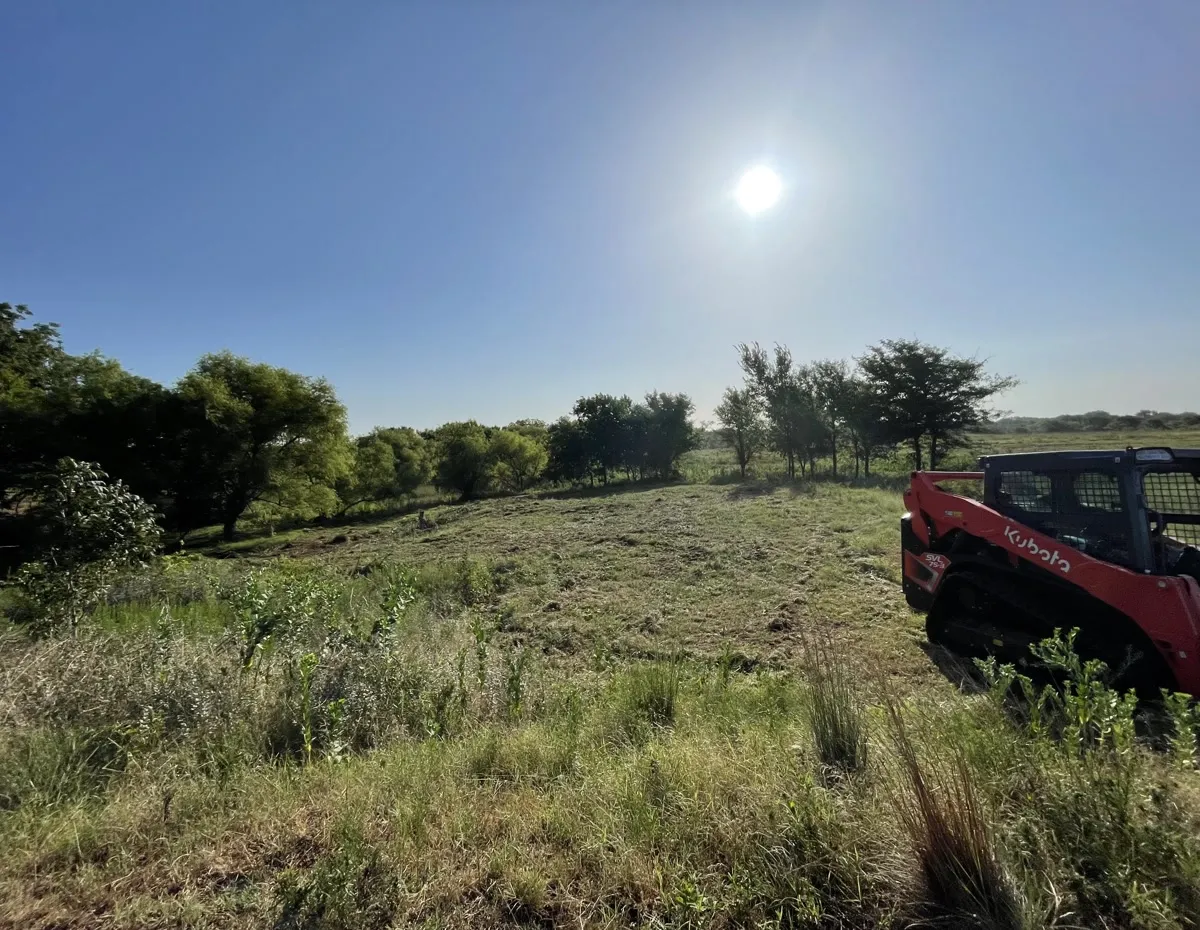
Our lane in all this is the mechanical middle: skid steers and the brush cutter for sapling-to-mid-size stands, the excavator where stumps need to leave for pads or fence lanes, piling for burns, hauling when the ground needs to be clean. Big closed-canopy timber wants bigger machinery than ours, and we will say so when that is what we find.
Who helps pay for cedar removal in Oklahoma?
More help exists than most landowners realize, and it comes through two doors, both real and both primary-source verifiable.
Door one is the Oklahoma Conservation Commission’s locally led cost-share program, run through your county conservation district. The current program year puts brush management on the approved state practice list, reimburses up to 85 percent of the cost, and caps payments at $7,500 per participant. The catch: each district picks its own practice menu every year, so the move is to call the Stephens County Conservation District office in Duncan and ask whether brush management is funded this round. You apply, the work gets done to NRCS specs, you submit invoices, the district reimburses.
Door two is NRCS EQIP, the federal program, which funds brush management in Oklahoma and takes applications year-round at the local USDA service center, with periodic ranking deadlines for funding. NRCS has also been pushing the Great Plains Grassland Initiative, which exists specifically to pay for removing encroaching trees like cedar to restore prairie, and Oklahoma ranchers were among its first enrollees.
Neither program is instant money; both start with paperwork and a conservation plan. But 85 percent cost-share turns a five figure clearing project into a four figure one, and we are glad to time the work around a program approval.
What keeps the cedar from coming back?
Nothing regrows from the stumps; everything regrows from the birds. Hundreds of new seedlings can show up in a year on cleared ground, per the Conservation Commission, so the follow-up plan matters more than the clearing method. The two proven tools are prescribed fire every few years, which OSU recommends where burning is practical, and a yearly mowing pass that shreds seedlings while they are still ankle high. Either one holds the ground for a fraction of the original job.
The grass, for what it is worth, takes care of itself. OSU’s guidance notes reseeding after cedar removal is generally unnecessary; the native grasses come back on their own once the trees stop drinking first. It is one of the few problems out here that stays fixed when you stop paying it attention, provided the seedlings never get their decade.
Common questions about cedar removal
Will a cedar tree grow back from the stump?
No. Extension guidance is unambiguous: eastern red cedar will not sprout from a cut stump, as long as the cut lands below the lowest green branch. No herbicide needed. The regrowth threat is new seedlings from bird-dropped berries, so cleared ground wants a follow-up plan of mowing or fire.
Is eastern red cedar invasive in Oklahoma?
It is native, historically confined to rocky ground that wildfire could not reach, but fire suppression let it loose. OSU Extension and the Oklahoma Conservation Commission treat the spread as an invasion, with NRCS estimating 762 newly infested acres per day statewide. It was named the state’s top conservation concern for USDA cost-share back in 2002.
How much water does a red cedar actually use?
OSU’s measured research puts the average around 6 gallons per day per tree, with a 12 inch tree peaking at 42 gallons on a hot day and much less in winter. Cedars transpire year-round, and OSU pegs an acre of them at absorbing around 55,000 gallons a year, plus canopy that intercepts rain before it reaches the ground.
Can I get cost-share help for cedar removal in Oklahoma?
Yes, through two doors. The Oklahoma Conservation Commission’s locally led cost-share program reimburses up to 85 percent, capped at $7,500 per participant in the current program year, through your county conservation district. NRCS EQIP also funds brush management, with applications taken year-round at the USDA service center.
What is the average cost to cut down a cedar tree?
One yard tree at a time, national guides price cedar removal around $500–$2,000 depending on height. Pasture-scale work is a different economy: OSU’s published estimates run $25–$100 per acre for mechanical control depending on tree size and density. Which economy your job falls in depends on how long the cedars have had.
When is the best time of year to clear cedars?
Any time, because cutting kills cedar in every season. Winter has one practical edge: cedar is the only thing still green, so scattered trees are easy to spot and count against bare ground. Burn piles cut in any season need to cure before they burn, and burn bans and wind set that schedule more than the calendar does.
Get ahead of the 762 acres
Every year a cedar stand gets is a year the job costs more and the grass gives back less. If cedar is moving into your ground around Duncan, Marlow, Comanche or anywhere in Stephens County, get in touch. We will come look at the stand, tell you what size class you are dealing with, point you at the cost-share if it fits, and quote the removal for free.