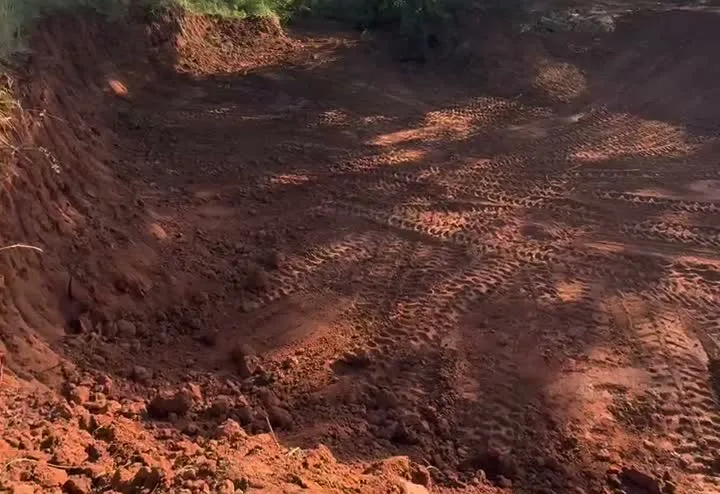
Land Grading and Dirt Work Cost in Oklahoma: 2026 Prices
Rough grading costs $1 to $2 per square foot in both Lawn Love and HomeGuide’s 2026 data, and a typical residential regrade lands between about $770 and $3,500 across the four big national cost guides. Fill dirt runs $5 to $25 per cubic yard bulk. Full-acre reshaping is its own category, published at $15,000 to $45,000 an acre.
Around Duncan, dirt work is really water work: our red clay holds every drop it is not shaped to shed. What the published numbers say, what moves them, and what our ground adds, all below, from the dirt work and grading side of our operation.
What does grading cost in 2026?
| Job | Published cost | Source |
|---|---|---|
| Finish grading, per sq ft | $0.08–$1.00 | Lawn Love 2026 |
| Rough grading, per sq ft | $1.00–$2.00 | Lawn Love, HomeGuide 2026 |
| Typical yard regrade, total | $770–$3,486 | Lawn Love, Thumbtack, Fixr |
| Regrade for drainage, whole house | $1,000–$3,000 | HomeGuide 2026 |
| Full acre, graded end to end | $15,000–$45,000 | Lawn Love, Fixr |
| Operator with machine, hourly | $100–$300 | HomeGuide 2026 |
The averages cluster tight: Lawn Love says $1,700, Fixr $1,800, Thumbtack about $1,900. Those are market figures, not our quote. What moves a real bid is how much dirt has to move, how far it moves, whether material comes in or goes out, and how tight the access is. A backyard reached through a 10 foot gate prices differently than open pasture, even at the same yardage.
Fill dirt has its own line: $5 to $25 per cubic yard bulk in HomeGuide’s data, roughly $150 to $600 for a delivered truckload of 10 to 15 yards, and more per yard for select or structural fill. Around Duncan, delivered marketplace listings run higher than those national bulk numbers, which is the haul distance talking.
Why is dirt work mostly water work in Oklahoma?
The Oklahoma Geological Survey reports that over 75 percent of the state’s bedrock units can produce expansive soils, clays that swell up to 1.5 to 2 times their dry volume when they get wet, then shrink hard as they dry. That cycle is why slabs crack, why yards heave, and why a grade that ignores water does not stay a grade for long here.
OSU Extension’s drainage guidance says the quiet part out loud: lots are supposed to slope away from the house, and settling erases that slope over the years until water ponds against the foundation. The residential code Oklahoma adopts sets the target at 6 inches of fall in the first 10 feet. Most wet-crawlspace and soggy-yard calls we take fail that one measurement.
Storms are the other half. OSU’s erosion research puts runoff at 10 to 20 percent of rainfall on grassed ground and up to 60 to 70 percent on bare soil. A fresh grade needs to be shaped to route a gully washer, then covered or seeded before one shows up. During the state’s record rains, OSU noted the worst yard flooding hit lots where builders had scraped the topsoil and compacted the clay underneath. Water has nowhere to go on ground like that except sideways, toward whatever is lowest. Grading picks what that is.
What does a drainage fix actually cost?
Cheapest first. Regrading one side of a house so water falls away runs $500 to $1,000 in HomeGuide’s data, and $1,000 to $3,000 for the full perimeter. A swale, which is just a shaped shallow path that gives runoff its own route, runs $5 to $15 per linear foot. Those numbers fix the majority of wet-yard problems because most wet-yard problems are shape problems.
French drains are the step up: around $5,000 average per LawnStarter, $10 to $65 per exterior linear foot, and our French drain cost guide has the full table. Worth it where surface shape genuinely cannot solve it, oversold everywhere else. Our habit is to read how the ground drains before recommending anything, and to say so when a gutter extension or a $600 swale beats a $5,000 pipe. Sometimes the cheap fix is the right one, and pretending otherwise costs you our credibility on the next job.
Dirt work also frames the bigger projects. A building pad is grading with higher stakes, and we priced that work separately in our building pad cost guide. Driveways live and die by the same drainage rules, covered in the gravel driveway cost guide.
What jobs fill a dirt work week around Duncan?
The everyday list: backyards regraded so rain stops creeping at the back door. Washouts on slopes rebuilt and shaped to stop leaving. Construction-roughed ground smoothed back to mowable. Old barn lots and feedlot ground knocked down and spread. Low spots filled with brought-in dirt, worked in lifts so they stay filled. Spoil piles from someone else’s project loaded and gone.
None of that prices off a chart. What the ground is doing versus what you need it to do is a five minute conversation standing on it, and a guess over the phone helps nobody. The visit is free.
Common questions about grading and dirt work cost
How much does it cost to grade a 1 acre lot?
Grading a full acre end to end is priced at $15,000–$45,000 in Lawn Love and Fixr’s 2026 guides, which surprises people. The catch is that almost nobody needs a whole acre reshaped. Most acreage jobs grade the problem areas, a pad, a drainage path, a washout, and cost a small fraction of that.
How much does fill dirt cost delivered?
Bulk fill dirt runs $5–$25 per cubic yard in the national guides, with a 10 to 15 yard truckload landing around $150–$600 delivered. Around Duncan, marketplace listings price fill dirt higher by the ton than national bulk figures, so haul distance from the pit is worth asking about on any quote.
How much slope should ground have away from a house?
The residential code Oklahoma has adopted calls for the ground to fall at least 6 inches in the first 10 feet away from the foundation. Where a lot line or structure will not allow that, the code lets a swale or drain do the work instead. Most soggy-foundation problems around here fail exactly that test.
Can I grade my yard myself?
Shallow low spots, sure: topdressing with a soil and sand mix is a normal homeowner fix. Once dips or humps pass about 3 inches, the guides recommend machine regrading, and rental equipment runs $265–$500 a day before you have moved a yard of dirt. Machine work also gets the slope right, which is the actual point.
What time of year is best for dirt work in Oklahoma?
Drier stretches, which usually means late summer through fall. Dry soil moves and compacts predictably, and a fresh grade gets time to settle before spring storms test it. Red clay worked wet turns greasy, then bakes into whatever shape it was left in, so weather windows matter more here than the calendar.
How much does fixing yard drainage cost?
Regrading so water falls away from the house runs $500–$1,000 for one side and $1,000–$3,000 for the whole perimeter in HomeGuide’s 2026 data. A swale runs $5–$15 per linear foot. French drains are the expensive route, averaging around $5,000 per LawnStarter, so we try grade first.
Get your dirt read in person
If your yard holds water, your slope is leaving in every storm, or your ground needs to be something it is not yet, the useful next step is eyes on it. We work Duncan, Marlow, Comanche and the rest of Stephens County. Get in touch and we will come look, tell you what the ground is doing, and quote the fix for free.