Bush Hogging Cost Per Acre: What It Runs in 2026
Bush hogging costs about $60 to $250 per acre in published 2026 contractor guides, with most maintained-to-moderate jobs falling between $70 and $120. Hourly, machines with operators run $60 to $150 in the same guides. University farm custom-rate surveys publish lower numbers, $17 to $47 per acre, which tells you something useful about how this work gets priced.
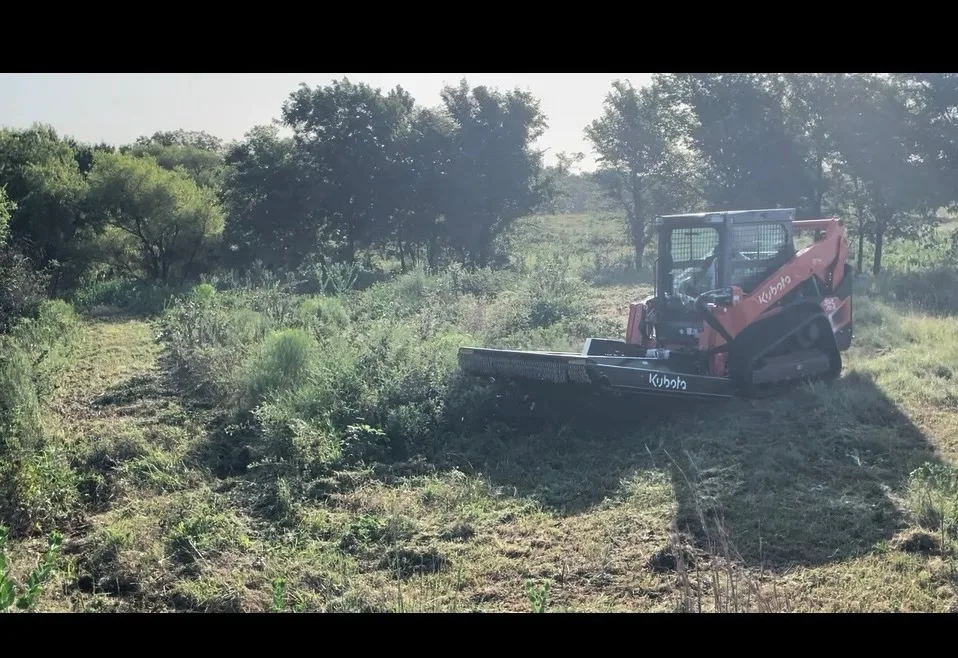
Around Duncan we run this work with a hydraulic brush cutter on a track skid steer, the heavy end of the brush hogging spectrum. What follows: the published numbers, why they spread so wide, and how to tell which price tier your ground sits in.
What does bush hogging cost in 2026?
| Ground condition | Typical per-acre price | Source |
|---|---|---|
| Maintained pasture, yearly cut | $50–$90 | Well Built Florida, LawnCareGrandpa |
| 2–3 seasons overgrown, stems to 2–3 in. | $100–$150 | Well Built Florida, Ricky’s Bobcat |
| Heavy brush, saplings 3–4 in. | $140–$350 | Well Built Florida, LawnCareGrandpa |
| Farm survey benchmark, open ag ground | $17–$47 | Ohio State 2022, Texas A&M 2026 |
| Hourly, machine + operator | $60–$150 | LawnCareGrandpa, Well Built Florida |
| Minimum call-out | $150–$350 | Well Built Florida, Bear Claw |
The two price worlds are worth understanding. The farm survey numbers, like Ohio State’s $17 per acre average and Texas A&M’s 2026 statewide $46.73 for pasture shredding, describe farmer-to-farmer custom work: big open fields, wide ag cutters, no mobilization to speak of. The contractor market prices small parcels, travel, insurance and rough ground. The closest published benchmark to us is Texas A&M’s 2026 North region, the counties right across the Red River, at $55.70 per acre average with $35 the most common answer on open pasture.
Only one Oklahoma operator we could find publishes a rate at all: $90 per hour for tractor and brush hog work in Oklahoma City. Everyone else quotes by eyeball, and there is a reason. Two fields of the same acreage can be a two hour job and a two day job. The look at yours is free, and the quote comes from the growth, not the acreage.
Why does overgrowth move the price so much?
Stem diameter is the whole story. Grass and weeds cut at road speed. Briar and two-year saplings cut slower. By the time stems reach 2 to 3 inches, a standard-duty cutter is over its head, and the published equipment classes back that up: standard rotary cutters are rated to about 1 inch, heavy-duty models to 3 or 4.
Pace collapses as stems thicken, and price follows. In open grass, a 6 foot cutter covers 2 to 2.5 acres an hour. In heavy brush, published guides put the same job at under an acre an hour, sometimes 2 to 4 hours per acre. Same field, same machine, triple the time.
That is also why waiting costs more than mowing. A field cut every year stays in the top row of the table. Skip two or three growing seasons in this climate and parts of it move down a row. Give it ten quiet years and you are no longer buying mowing at all; you are buying land clearing, at several times the acre price. We wrote up how to tell which side of that line your ground is on in brush hogging vs. land clearing.
What can a cutter kill, and what just gets a haircut?
A rotary cutter controls what it cuts; it does not always kill it. The Noble Research Institute down at Ardmore is blunt about it: species like elm, persimmon and mesquite resprout from the roots after mowing. In their words, you have basically made the plant mad. Mowing holds that brush at bay, which is real value, but killing it means digging roots, which is clearing work.
Cedar is the useful exception. Cut a cedar below its lowest green branch and it is dead, no resprout, no chemical. A heavy cutter shreds cedar seedlings and saplings by the hundred, which makes a yearly mowing pass the cheapest cedar control there is. Once cedars are past cutter size, that same job belongs to our cedar removal side of the business.
Where the skid steer earns its keep over a tractor rig: banks, ditches, pond dams, tight corners and soft spots. Tracks float where wheels rut, and the machine turns in its own length, so edges get cut instead of skipped. The stuff a tractor mows around is usually the stuff you most wanted gone. A dam kept mowed is a dam that lasts, which matters once you see what a stock pond costs to build or clean out.
How often should you mow, and when?
Extension guidance is more aggressive than most landowners expect: clip at least twice a year, before weeds set hard seed, if weed control is the goal. Iowa State’s pasture research adds that repeated mowing drains the root reserves of perennial weeds over a couple of seasons, which is how a rough field gradually becomes a clean one.
The practical Oklahoma rhythm for most ground is one solid annual cut, late summer or fall, after the growth flush and before seed drop. Remote parcels get by on that. Road-visible lots and anything the city sends letters about usually want two. A standing yearly cut is the cheapest version of this service we sell, because the ground never gets ahead of the machine.
Common questions about bush hogging cost
How much does it cost to bush hog 5 acres?
At the published $60–$120 per acre market range, a maintained 5 acre field runs about $300–$600, and one Florida operator publishes $300–$750 for exactly that size. Ground left to grow 2 or 3 seasons climbs toward $700–$1,000 because thicker stems cut slower. At 5 acres you are safely past most minimum charges.
How many acres per hour can a bush hog mow?
In open grass, a 6 foot cutter covers about 2 to 2.5 acres an hour, and an Oklahoma City operator publishes just under 2 acres an hour with a 7 footer at 3 mph. Heavy growth cuts that pace hard. Thick brush can drop any machine to under an acre an hour, which is where per-acre prices climb.
Why do bush hogging companies have minimum charges?
Because the machine has to get there. Published guides show $150–$350 call-out minimums, which cover loading, hauling and unloading that happen whether the job is one acre or ten. Small lots price as a machine-hour plus travel. Bundling a neighbor’s lot or adding a second task on the same trip beats arguing the minimum.
How often should Oklahoma pasture be bush hogged?
Extension guidance says clip at least twice a year for real weed control, timed before seeds harden. In practice, one solid cut a year holds most Oklahoma pasture, usually late summer or fall after the growth flush. Skip two or three years and part of the field graduates from mowing prices to clearing prices.
How thick can brush get before it is not a mowing job?
Go by stem diameter, not height. Standard rotary cutters are rated to about 1 inch, heavy-duty cutters to 3 or 4 inches per the published equipment classes. Contractors price 2 to 3 inch stems as heavy brush work, and past 3 to 4 inches the job crosses into land clearing territory with different equipment and prices.
How much does it cost to mow 20 acres?
At published market rates of $40–$120 per acre for maintained to moderate growth, 20 acres runs roughly $800–$2,400, and per-acre discounts are normal on big open tracts because the machine never stops. Farm custom-rate surveys benchmark lower, $17–$47 per acre, which is neighbor-with-a-tractor pricing, not contractor pricing.
Get your field priced off the field
Acreage is half the answer; the growth on it is the other half. If your pasture, lot or hunting ground around Duncan, Marlow, Comanche or the rest of Stephens County has gotten ahead of you, get in touch. We will come look, tell you what is mowable and what is past mowing, and quote the actual cut for free.